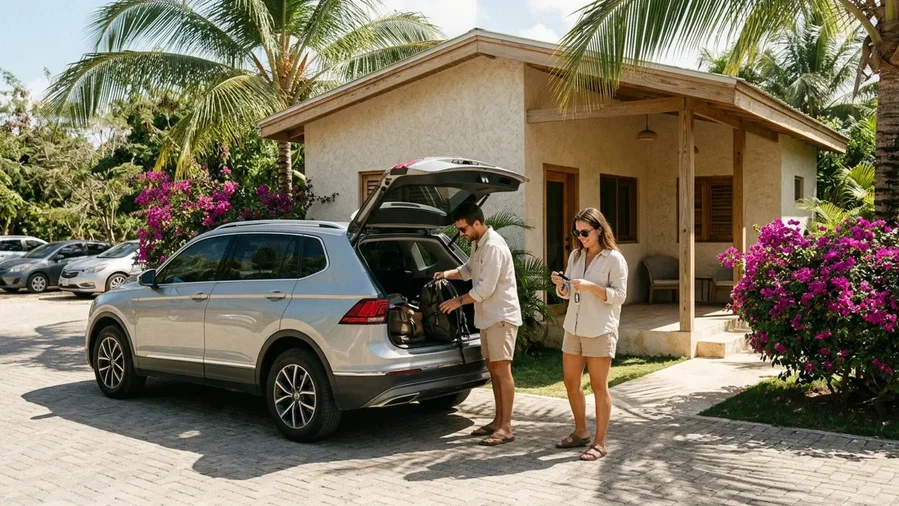



Renting a car in Punta Cana makes the most sense when you intend to explore independently, not spend every day inside a resort. The decision comes down to your itinerary, the complete rental price and how comfortable you are driving in the Dominican Republic.
A low daily rate is just the starting point. Understand the local insurance requirements, deposit, credit-card conditions, airport collection, hotel parking and the restrictions in your contract. This guide explains what to check without suggesting that one advertised price is guaranteed.
Is a rental car worth it in Punta Cana?#
| Your holiday plan | First option to consider | Why |
|---|---|---|
| A week at an all-inclusive with one excursion | Airport transfer plus an occasional taxi | A parked car still costs money |
| A private villa with supermarket runs and beach trips | Compare a rental against several taxi fares | Independent stops may justify the cost |
| Exploring Macao, Higüey or several districts in one day | Rental car if you are a confident driver | Flexible route and departure times |
| Late flight arrival followed by a resort stay | Prebooked airport transfer | Avoid driving tired in the dark |
| Family with children and luggage | Suitable rental vehicle or booked driver | Seat and luggage capacity must be confirmed |
| Unfamiliar with assertive traffic | Professional driver or guided excursion | Less stress and less driving risk |
A rental is not essential for every Punta Cana holiday. If you mainly need short trips to restaurants or the beach, see our guide to taxis, fares and Uber.
Where to pick up a rental car#
Punta Cana International Airport (PUJ)#
The official airport transportation page lists on-site car rental companies including Avis, Budget, Payless, Europcar, Hertz, Dollar, Thrifty, Enterprise, National, Alamo and Sixt. Desk assignments and opening hours can change. Always check the terminal, shuttle arrangements and branch hours on your specific confirmation.
An airport pickup is useful if you need a car from the first day. But it may not be the easiest plan after a late flight. Check whether airport charges are included and whether an out-of-hours handover is actually available.
Bávaro, Cap Cana and local branches#
There are also car rental offices outside the airport, including in Bávaro and Cap Cana. Collecting locally can make sense if you only want a car for two or three days. Compare collection and return charges and ask whether the company will deliver the vehicle to a hotel or villa.
Check whether the accommodation has guest parking, whether its gate allows rental-vehicle access, and whether the car can be left there overnight.
How much does renting a car really cost?#
Rental prices vary by date, class, availability and insurance terms. Quotes from booking websites may not include exactly the same local protections as the final counter agreement. Compare the total payable amount, not just the daily headline.
| Cost item | What to confirm |
|---|---|
| Base rental | Total number of days and exact vehicle class |
| Third-party liability (TPL) | Is local liability coverage included or required separately? |
| Collision/theft waiver (CDW/LDW) | What exclusions and deductibles apply? |
| Card deposit | How much available credit will be held? |
| Airport and location fees | Any extra charge for PUJ pickup? |
| Extra or younger driver | Age limits and surcharges |
| Fuel, mileage and tolls | Return fuel level, mileage cap and toll payment |
| Parking, car seat and one-way return | Whether these have additional charges |
Illustration only, not an actual rental quote: a car advertised at $35 per day for four days has a base price of $140. If required protection and fees add another $30 per day, the total before fuel becomes $260. These sample amounts simply demonstrate why you should not compare a $35 headline against a complete taxi price. Your actual offer may be much higher or lower.
Insurance: the most important terms#
The phrase «insurance included» does not establish what is covered. Read the local contract and confirm the actual excess.
Third-party liability versus vehicle damage protection#
Third-party liability (TPL) applies to damage or injury involving other people. Collision Damage Waiver / Theft Protection (CDW/TP or LDW) concerns your contractual responsibility for the rented vehicle, subject to exclusions. These are different protections.
As one concrete example, Enterprise’s published terms for a Punta Cana location say TPL is required unless a specified protection package is purchased. The same branch sets conditions for accepting proof of credit-card collision protection and says third-party travel-site collision coverage is not accepted there. These are conditions for that particular office, not a national rule for every rental operator.
Ask the rental counter for written confirmation before paying a nonrefundable reservation. If relying on card benefits, check both the credit-card insurer’s Dominican Republic eligibility and the local supplier’s documentation requirements.
Deposit and credit-card holds#
A deposit authorization is usually not an extra rental fee, but it temporarily reduces available credit. Many offices want a physical credit card in the main driver’s name; debit-card acceptance varies. Do not assume the name on someone else’s card will be accepted.
Check the hold amount, accepted card types, damage deductible and release process for your specific car, branch and booking.
Driver’s licence, age and documents#
The Dominican Republic tourism board FAQ says a valid licence from your home country can be used during a legal tourist stay. A rental company can still impose additional conditions.
Bring:
- Your original valid driving licence for each registered driver.
- Passport and any documents requested at the branch.
- A valid credit card in the primary driver’s name, with enough available credit.
- Reservation confirmation and written coverage details.
- An International Driving Permit or certified translation if required by your licence’s script or rental contract. An IDP does not replace the original licence.
The minimum age differs between providers. General tourism-board car hire guidance refers to age 25, while some Enterprise locations publish a minimum age of 21 and a younger-driver fee. Verify the actual age and vehicle-class restrictions of the supplier you are booking, rather than applying one figure to every rental desk.
Driving in Punta Cana: what to expect#
Traffic drives on the right. Main routes between tourist districts tend to be better maintained than rural roads, but drivers can encounter motorcycles, pedestrians, poorly marked speed bumps, potholes and limited street lighting.
The Government of Canada’s travel advice warns about frequent road accidents and recommends defensive driving and daytime travel where possible. This does not mean every drive is unsafe; it means planning matters.

Keep your first drive simple#
If you have just landed after a long journey, consider a transfer and collect the car the next morning. Set navigation before leaving, allow more time than the shortest mapping estimate and keep fuel in the tank for detours.
Watch for motorcycles on both sides, avoid unexpected braking and slow down well before standing water or unmarked speed bumps. Plan unfamiliar rural routes for daylight. If you do not feel comfortable driving after dark, arrange another way back.
Inspect the vehicle before leaving#
Take photos or a continuous video of every panel, wheels, windows, interior, fuel gauge and dashboard. Have any existing damage written into the agreement. Check child seats, spare-wheel equipment and the rental company’s emergency phone number. For a collision or breakdown, follow the operator’s reporting requirements and applicable local procedures.
Which areas justify a car?#
Bávaro and Los Corales#
Some accommodations are near restaurants and services, making an occasional taxi more convenient than a daily rental. Parking varies by property. Read our Bávaro area guide before deciding.
Cap Cana and villa stays#
A car may be useful for supermarket runs and independent trips from a villa away from amenities. Confirm gate access and parking, including guest vehicles. See our Cap Cana versus Bávaro guide for the broader location choice.
Macao and Uvero Alto#
These districts are less central to many Bávaro facilities. A rental gives freedom, but plan road conditions and the return journey carefully, especially in bad weather. Our Uvero Alto guide explains the area’s layout.
Seven checks before booking#
- Compare the complete price, with all required insurance and fees.
- Identify the supplier behind a comparison-site offer and read its own rules.
- Confirm deposit and card requirements, including any held credit.
- Check every driver’s age and licence, and translations where needed.
- Verify the pickup location, terminal, shuttle and opening hours.
- Book the right car, including luggage space, automatic transmission and child seats.
- Save the emergency procedure and damage-reporting contacts offline.
Frequently asked questions#
Can you rent a car at Punta Cana Airport?#
Yes. PUJ confirms multiple rental operators at the airport. Confirm the desk, terminal and hours for your reservation.
Do you need an International Driving Permit?#
Not automatically in every case. A valid foreign licence is generally recognized during a legal tourist stay, while some rental offices require an IDP or certified translation for licences with non-Latin characters. Check the particular branch.
Is renting cheaper than taking taxis?#
It depends. Occasional taxis may cost less than a rental that sits parked all week. Several independent journeys each day may make a car worthwhile. Compare all-in rental costs with your intended taxi trips.
Should you drive at night?#
Official travel guidance recommends caution and limiting unfamiliar night journeys. A scheduled transfer or professional driver is a reasonable alternative after a late arrival.
The bottom line#
A rental car can be a good choice when you will genuinely use it to explore and are confident driving locally. Get a written, complete price; confirm local insurance, deposit and driver conditions; and inspect the car. For a hotel-focused holiday, a transfer and the occasional taxi may be more comfortable.
Images in this guide are illustrative, not photographs of a particular rental company or PUJ counter.