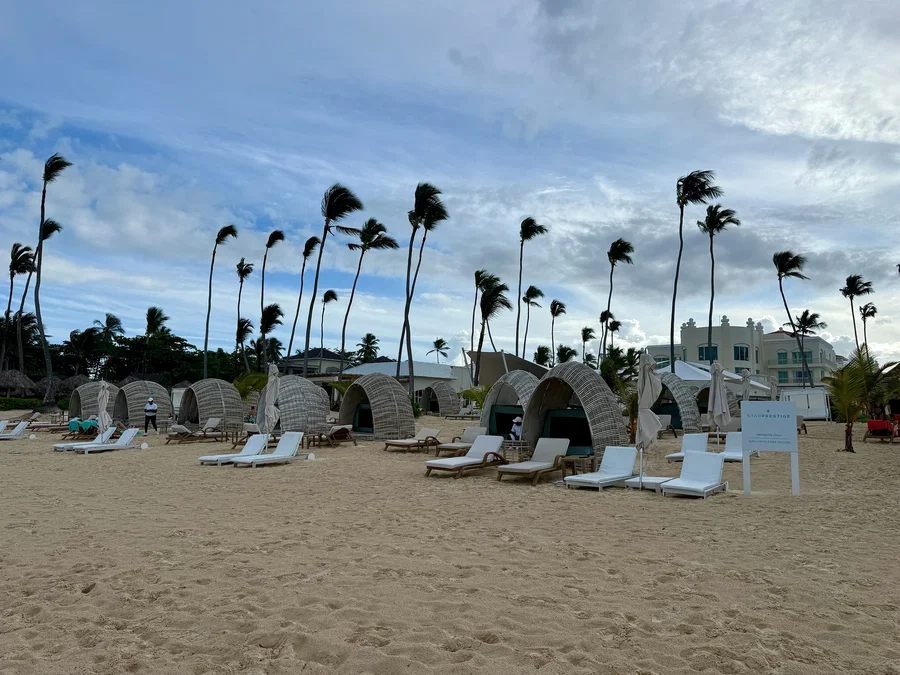



Punta Cana has a sargassum season, but not a dependable month when every beach is covered or a month when every beach is guaranteed clear. Floating brown seaweed can arrive in large amounts, disperse with changing winds and currents, or collect on one stretch while another looks different.
If you’re choosing a hotel or deciding when to visit, the useful questions are which exact beach you will use, how recently its conditions were checked, and what alternatives you have if seaweed arrives. A dramatic photograph from another year cannot answer those questions.
Across the tropical Atlantic and Caribbean, floating sargassum often grows through part of the spring and summer and declines later in the year. But the timing and magnitude change. The University of South Florida (USF) publishes monthly satellite outlooks, and NOAA offers shorter-term coastal inundation risk estimates. Neither guarantees the condition of any Punta Cana hotel beach.
Here is how to read those sources and plan a trip without relying on an invented seaweed-free season.
What is sargassum, and why does it reach Punta Cana?#
Sargassum is a naturally floating brown seaweed, not sewage or evidence that a hotel has neglected its beach. Offshore mats provide habitat and shelter for marine life, including young fish and sea turtles. Problems develop when huge quantities drift close to shore and pile up.
Wind and currents can carry the algae long distances across the Atlantic and Caribbean. Punta Cana occupies the eastern coastal part of the Dominican Republic, so the movement of floating material offshore can affect sections of the destination’s beaches.
Small scattered strands may have little effect on a beach day. A large influx can discolor nearshore water, obstruct swimming and create unpleasant conditions as it decomposes. Sargassum is also different from attached seagrass: people often use the word seaweed for several kinds of material.
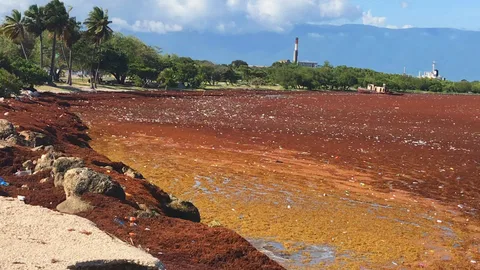
The photograph below shows what accumulated sargassum can look like in the Dominican Republic. It was taken in Barahona Province in 2021, not in Punta Cana, and does not represent current conditions at any resort.
When is seaweed season in Punta Cana?#
The broad seasonal tendency is higher regional sargassum during parts of spring and summer, followed by a decline later in the year. That is not a fixed calendar for a particular hotel. Each year differs, and seaweed already floating offshore may wash ashore even after regional quantities begin decreasing.
| Travel period | How to interpret the pattern |
|---|---|
| Winter | Regional amounts have often been lower after the seasonal decline, but no beach is guaranteed clear |
| Spring | Floating biomass may build; follow current scientific outlooks and recent local observations |
| Summer | Large offshore accumulations and coastal arrivals have occurred in many years; check the exact beach and hotel cleanup arrangements |
| Autumn | The regional amount often declines, but stranded material and new arrivals can still affect individual beaches |
These are qualitative tendencies, not calculated probabilities for Punta Cana. One month’s experience does not reliably predict the following year.
For example, the USF outlook dated September 30, 2026 reported falling regional sargassum amounts after summer, while some regions still remained elevated against earlier years. That observation does not establish whether Bávaro, Uvero Alto or Cap Cana was clean on October 22.
If you are booking several months ahead, treat seaweed as one of the destination’s changing natural conditions. If you are traveling next week, a recent local photograph and today’s marine conditions will be more informative than a broad season chart.
How to check seaweed conditions before visiting#
No satellite image can promise how the sand in front of a resort will look at check-in. The strongest approach combines scientific monitoring with recent local evidence.
| Source | What it helps with | Its limitation |
|---|---|---|
| USF Sargassum Watch System | Monthly regional satellite trends and outlooks | Does not forecast the exact amount on an individual hotel’s sand |
| NOAA Coastal Inundation Risk | Coastal risk estimates from nearby observed floating mats | Does not show whether a hotel’s cleaning team removed algae that morning |
| Your hotel or local host | Dated pictures, beachfront cleaning and swimming-area alternatives | Cannot guarantee future offshore arrivals |
| Recent traveler photos | Independent observations of an identifiable stretch of beach | A photo without a verifiable location and date can mislead |
NOAA’s risk method uses nearby floating material within a neighborhood of roughly 50 to 100 kilometers around coastal pixels. Treat its categories as risk signals, not a personal beach forecast, a webcam or a water-quality test.
Check at three useful moments#
About a month before departure: Read the latest USF outlook and its publication date. Compare the larger regional trend with earlier months without extrapolating to a named resort.
Three to seven days before arrival: Ask the hotel for an unedited, dated photo or short video of its actual beachfront. For a vacation rental, identify which public beach entrance you plan to use before requesting local conditions.
On the day: Look at the precise section where you want to swim. Consider warning flags, waves and boat traffic separately from the quantity of seaweed. Do not assume a clear-looking patch offshore is a safe swimming zone.
You can also ask when the photo was taken and whether it shows the current beach rather than a marketing image from another season.
Which beaches in Punta Cana are least affected?#
There is no reliable permanent ranking of Punta Cana beaches by sargassum. Wind, currents, coastal shape and cleanup activity can produce different conditions at locations that are not far apart. A beach clear during one influx may be affected during the next.
| Beach or district | What to check |
|---|---|
| Bávaro, Los Corales and El Cortecito | The particular access point, recent waterline photos and services at that section |
| Arena Gorda | The specific resort frontage and its beach-management arrangements |
| Uvero Alto | Offshore arrivals, exposure to Atlantic surf and the hotel’s designated swimming alternatives |
| Macao | Conditions at the public surf beach on the date of your outing |
| Cap Cana, Juanillo and Playa Blanca | Both current conditions and any venue access or reservation arrangements |
| Cabeza de Toro | Your exact property and the conditions directly in front of it |
A resort-managed beach may look tidier after collection, but hotel fees do not create an immunity from seaweed. Similarly, a public beach is not always worse; it simply may have different maintenance arrangements.
Our Best Beaches in Punta Cana comparison explains the wider trade-offs. The Bávaro Beach public-access guide covers Bibijagua, Los Corales and El Cortecito if you want to investigate a particular public approach.
What do Punta Cana resorts do about sargassum?#
Some properties arrange collection along their frontage, coordinate with local authorities or use containment systems. Results depend on how much arrives, the local water, the coastline and environmental rules. A beach may be cleaned in the morning and receive more floating material later.
The Dominican Republic’s Ministry of Environment has established guidance for collection under Resolution 0046-2025, addressing containment, environmental impacts, removal and disposal. It does not promise that every Punta Cana beach is cleaned daily.
Instead of asking whether a resort is always seaweed-free, try these questions:
- Is your actual swimming frontage cleaned when sargassum arrives, and who manages it?
- Can the property share a recent photo dated within the past few days?
- When the beach is heavily affected, which swimming pools or alternative activities are available?
- Does cleanup sometimes restrict parts of the shore or cause temporary machinery activity?
- Is there another accessible beach option, or would arranging transportation be necessary?
An offshore barrier, a private beach club or an expensive room rate cannot guarantee clear water for your travel dates.
Why isn’t all washed-up seaweed simply removed?#
Floating sargassum supports marine ecosystems. Collecting large deposits from the shore can disturb wildlife, remove sand, damage dunes or require careful handling of decomposing material. Disposal has environmental consequences too.
Cleanup needs to balance tourism with protection of the coast. The U.S. EPA’s management guidance explains why heavy machinery and handling require care. A hotel that gives clear, specific information is more useful to a traveler than one offering an absolute guarantee it cannot control.
Is sargassum dangerous to touch or swim through?#
Small amounts of floating seaweed are not, by themselves, evidence of pollution or a formal swimming advisory. Dense mats, however, are best avoided, especially if they contain debris or are actively decomposing.
NOAA and the U.S. EPA explain that large decaying accumulations can release gases including hydrogen sulfide, associated with a rotten-egg smell, and ammonia. Exposure can irritate eyes and airways, particularly for people with respiratory sensitivities. Small organisms living among the mats can also irritate the skin.
The practical precautions are straightforward:
- Avoid entering water packed with seaweed or debris.
- Stay away from large decomposing piles if you notice a strong smell or irritation.
- Keep children clear of machinery, collection areas and unattended piles.
- If you develop irritation or breathing discomfort, leave the affected area and avoid further exposure.
- Do not eat beach-collected sargassum or treat it as a health product.
Even if the beach has no seaweed, waves and currents still matter. For example, our Macao Beach access and swimming guide discusses the open Atlantic surf that attracts surfers but can be hazardous for casual swimming.
Should you change your hotel or dates because of seaweed?#
It depends on what you need from the holiday. If daily swimming in the ocean is essential, you have good reason to confirm the latest beachfront conditions and acceptable pool alternatives before departure.
For travel months ahead, switching between Punta Cana resorts solely because of last year’s seaweed photos is a weak prediction strategy. Instead compare practical beach management, swimming facilities, transport and written cancellation or change terms.
If a hotel advertises complimentary activities or private beach services, check what is truly included in your rate. Our Punta Cana hotel costs and inclusions guide helps distinguish facilities from extra charges.
For general accommodation locations, the Punta Cana Where to Stay guide considers walkability and transport. Seaweed alone should not determine whether the entire neighborhood suits your trip.
What if your beach is heavily covered?#
You can choose a pool day, a trip away from the coast or a different activity. If considering a second beach, confirm both its current condition and lawful visitor access before arranging a driver. A nearby beach is not guaranteed to be clear.
Be cautious about tours claiming guaranteed seaweed-free water. Ask where they go, what happens if weather or sea conditions change and whether the operator provides a reasonable alternative or refund.
If the problem concerns a hotel reservation, ask the property about its actual policies; seasonal seaweed is not, by itself, proof that any particular booking must be refunded.
October 2026: what do the latest regional reports show?#
Research snapshot: October 22, 2026. This section is dated context, not a live Punta Cana beach-conditions report.
USF’s September 30, 2026 sargassum outlook described a regional decline after summer, with some areas still exceeding historical comparisons for September. NOAA’s coastal inundation risk product adds coastal-scale indicators based on observed floating material.
The Dominican Ministry of Environment has also described sargassum response and environmental management efforts in the eastern part of the country. Those reports indicate that the destination takes the issue seriously. They do not prove that every Punta Cana beach is currently covered or that a named hotel is clear.
For later travel dates, open the newest available bulletins and contact the actual accommodation. Do not mistake this dated snapshot for a future forecast.
Frequently asked questions#
These common questions are best answered with a distinction between long-term regional patterns and conditions at one particular beach on one particular day.
Does Punta Cana have a guaranteed seaweed-free season?#
No. The broader floating sargassum cycle is seasonal, but individual beach arrivals and cleanups vary. No month should be treated as a warranty of clean sand.
Can I check sargassum on a satellite map?#
Yes. USF SaWS and NOAA publish specialized satellite products. They are useful for broader trends and risks, but cannot confirm the condition of a hotel beachfront after cleanup or replace a recent local photo.
Is Bávaro better than Uvero Alto for avoiding sargassum?#
There is no permanent evidence-based ranking. The shape of the coast, wind and local cleaning practices matter. Compare the specific hotel frontages and dates.
Does seaweed mean the seawater is polluted?#
Not by itself. Sargassum is a naturally floating algae. Very large accumulations can affect nearby conditions, but neither the presence nor absence of algae constitutes a formal water-quality result.
Can my resort guarantee that I won’t see sargassum?#
It cannot control future offshore arrivals. Ask for current photos, cleaning arrangements and a practical alternative plan if the beach becomes unsuitable.
How to plan with confidence#
Use regional satellite outlooks to understand risk, local dated observations to evaluate your beach, and your hotel’s facilities to plan for uncertainty. If you have fixed dates, a dramatic image from another country or year should not be the deciding factor.
There is no mythical stretch of Punta Cana that stays seaweed-free in all conditions. But there are straightforward steps that can make a vacation enjoyable even during a significant sargassum season.
Sources and further reading#
- University of South Florida: Sargassum Watch System - regional observations and monthly outlooks; September 30, 2026 bulletin consulted.
- NOAA AOML: Sargassum Inundation Risk - coastal risk product and method limitations.
- NOAA: Sargassum, From Sea to Shore - offshore ecological benefits and major coastal impacts.
- U.S. EPA: Sargassum Inundation Events and Human Health - exposure pathways and risk reduction.
- U.S. EPA: Managing Sargassum Inundation Events - cleanup and disposal considerations.
- Dominican Ministry of Environment: Sargassum response and Resolution 0046-2025 - environmental management requirements.
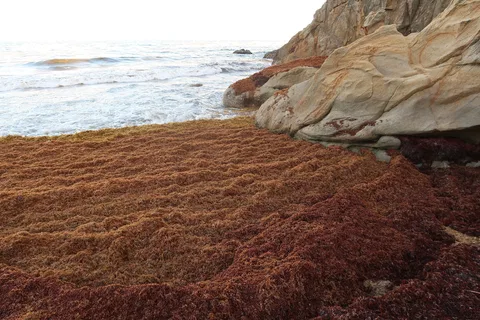
- Photo credits: Hero: Oleg Yunakov, Bávaro Beach No. 18, 2024, resized under CC BY-SA 4.0. Sargassum in the Dominican Republic: JonasGuevara, Barahona Province, 2021, resized under CC BY-SA 4.0. Close view: BrickLightning, Punta Tuna Beach, Puerto Rico, 2021, resized, CC0. All are historical; none verifies current Punta Cana conditions.